

The Stall and the Restart
Let's be honest about something: "Digital Transformation" has been the corporate buzzword for over a decade now. Companies have poured billions into cloud migrations, digitizing paper records, and implementing massive ERP systems. But if we're really being truthful, most organizations haven't seen the revolutionary change they were promised.
We said transformation, but what we got was incremental upgrades. We automated bad processes and made them slightly faster. We built massive data lakes but still couldn't find the insights we needed. Many companies ended up "digitized"-sure, they had digital assets-but they weren't actually "transformed." The fundamental way they created value hadn't really changed. The engine was running, but it wasn't going anywhere.
Then something shifted. The arrival of accessible, powerful Generative AI changed everything.
GenAI isn't just another tool in the IT toolbox. It represents a fundamental shift in what computers can do. Traditional AI analyzes existing data to make predictions or sort things into categories. GenAI actually creates-new content, working code, strategic scenarios, simulations. We've moved from an era of automation to an era where machines can augment human creativity and generate entirely new things.
At GTEMAS, we think we're finally standing at the edge of the real digital age. Companies that treat GenAI as just another cost-cutting tool will get marginal improvements at best. But the ones that recognize it as central to their business strategy? They're going to redefine entire industries.
As your global engineering partner, GTEMAS is here to help you navigate this territory. This article explores how GenAI isn't just changing the game-it's rewriting the entire rulebook.

Section 1: Understanding Why Digital 1.0 Hit a Wall
To figure out where we're going, we need to understand why previous digital efforts plateaued.
The Limitations of "Digital 1.0"
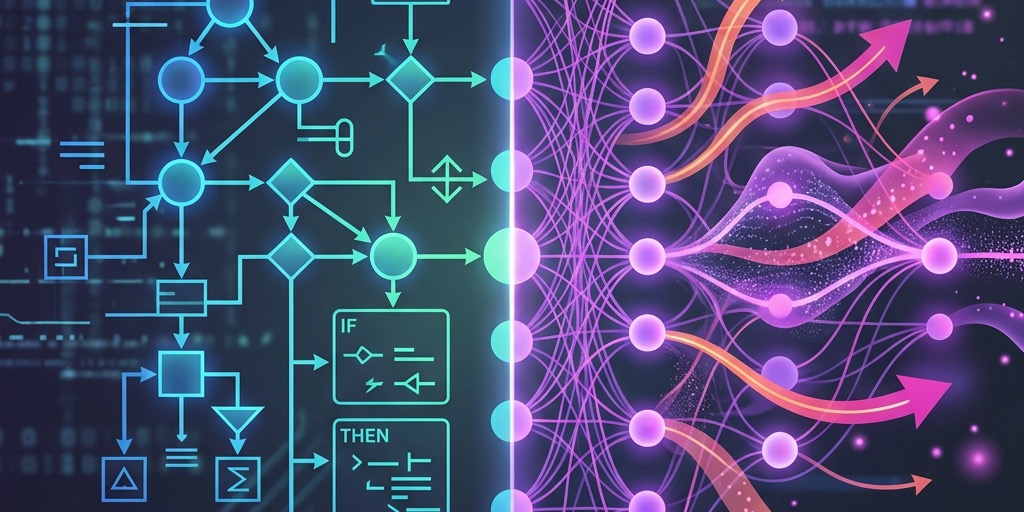
The first wave of digital transformation was mostly about efficiency and connectivity. Take physical processes, make them virtual. Move files to Sharepoint, customer records to Salesforce, infrastructure to AWS or Azure.
Necessary? Absolutely. Revolutionary? Not really.
Digital 1.0 had some fundamental problems:
- The data silo mess: Companies got really good at collecting data but terrible at actually using it. Structured data in neat rows and columns? Fine. But most corporate knowledge-buried in emails, PDFs, contracts, technical manuals-stayed locked away, useless to traditional analytics.
- Brittle automation: Remember when RPA (Robotic Process Automation) was going to change everything? Those bots were fragile. Change one button on a user interface and the whole thing broke. They could follow rules but couldn't understand context or deal with anything unexpected.
- The innovation gap: Digital tools helped us execute existing ideas faster, but they rarely helped us come up with new ones. Real innovation was still manual, human-intensive, and slow.
The GenAI Difference: Understanding, Not Just Processing
Generative AI, built on Large Language Models and foundational models, breaks through these limitations. It doesn't just process data-it actually understands it in ways computers never could before.
GenAI can read, synthesize, and generate human-like text, code, images, and complex models. It's the universal connector that Digital 1.0 was missing. It can read those PDFs that broke your RPA bots. It can draft code that used to take developers hours. It can simulate market scenarios that strategists used to just guess at.
GenAI shifts digital transformation from optimizing what you already know to exploring what you don't. It turns all that digital infrastructure you've built over the years into an active, intelligent partner in your business.
Section 2: How GenAI Actually Powers Transformation
If GenAI is the engine, how does it actually move your business forward? It impacts three critical areas: customer experience, operational speed, and product innovation.
Vector 1: Real Personalization and Customer Experience
For years, "personalization" meant putting someone's first name in a marketing email. Today's customers expect experiences that understand context, anticipate their needs, and feel genuinely individualized.
Traditional personalization grouped customers into segments based on past behavior. GenAI enables personalization down to the individual level.
- Conversational commerce: We're moving past those frustrating chatbots that kept saying "I don't understand." GenAI-powered agents can hold actual conversations, understand nuanced requests, solve complex problems, and act as personalized shopping assistants-drawing on your entire catalog and the customer's full history in real-time.
- Dynamic content at scale: Instead of creating one marketing campaign for thousands of people, GenAI lets you generate thousands of variations-copy, imagery, messaging-tailored to each recipient's profile, preferences, and current context. It's not just more efficient; it's fundamentally more effective.
Vector 2: Intelligent Operations
This is where things get really powerful. GenAI moves you from rigid automation to flexible, intelligent systems.
- Unlocking unstructured data: For many companies, this delivers the fastest ROI. An insurance company can use GenAI to instantly read thousands of pages of claims documents, medical reports, and policy contracts, then synthesize everything and recommend a decision to a human adjuster. What used to take days now takes minutes.
- Supply chain resilience: Traditional systems track where things are. GenAI predicts where they should be and what might go wrong. By analyzing news feeds, weather patterns, geopolitical signals, and historical shipping data, these models can simulate thousands of potential disruptions and suggest alternative strategies before problems hit.
- The augmented workforce: GenAI doesn't replace knowledge workers-it gives them superpowers. In finance, it catches subtle fraud patterns that rule-based systems miss. In HR, it drafts job descriptions, screens resumes against nuanced criteria, and creates personalized onboarding materials. It handles the tedious work of gathering and synthesizing information, freeing humans to focus on judgment calls and relationships.

Vector 3: Faster Innovation
The most exciting application is how GenAI compresses the innovation timeline.
- Software engineering acceleration: As a global engineering partner, we see this firsthand through FastDX, our AI-native delivery pipeline. GenAI tools aren't just auto-completing code-they're generating entire functions, converting legacy systems (COBOL to Java, for instance), creating unit tests, and documenting complex architectures. And it's not limited to coding: the same acceleration applies to requirements analysis, deployment automation, and production monitoring across the full SDLC. This reduces technical debt and frees engineers to solve high-level problems instead of wrestling with syntax.
- Generative design in manufacturing: In automotive and aerospace, engineers define performance parameters-"design a bracket under 1kg that can handle X force"-and the AI generates hundreds of novel designs, some that human engineers would never think of. Then you can test them all via simulation.
- Scientific discovery: In pharma and materials science, GenAI predicts molecular structures and simulates protein interactions, potentially cutting years off drug discovery timelines.

Section 3: What the C-Suite Needs to Know
For executives, integrating Generative AI is no longer optional-it's a survival issue. But moving from "ChatGPT is cool" to actual enterprise value requires a real strategy.
Leadership needs to shift from "doing digital" to "being AI-powered."
1. Your Data Foundation Matters
Here's an uncomfortable truth: GenAI is only as good as the data you feed it.
Many organizations jumping into GenAI are discovering their data foundations are cracked. Data is scattered, inconsistently labeled, or trapped in legacy systems. You can't build a skyscraper on quicksand.
Before deploying advanced models, you need solid data engineering. Create unified data architectures, ensure data quality, establish clear governance. Modern data infrastructure isn't optional-it's the prerequisite for everything else.
2. Humans and AI Work Together
The "AI will replace all jobs" narrative is both wrong and counterproductive. The winning approach is augmentation, not replacement.
You need to redesign roles and workflows to optimize the partnership between human judgment and machine speed. This requires serious investment in upskilling. Your workforce needs training not just on using AI tools, but on prompt engineering, critical thinking, and validating AI outputs.
Humans in the loop handle ambiguity, ensure ethical considerations, and provide the creative direction that guides the generative process.

3. The Governance and Ethics Gap
With powerful technology comes significant risk. Deploying GenAI introduces new challenges and compliance headaches.
- Hallucinations: Generative models can confidently state complete falsehoods. In business, that's dangerous. You need rigorous verification and "Retrieval-Augmented Generation" (RAG) architectures that ground the model in your actual corporate data.
- IP and security: Who owns AI-generated code? What happens when employees accidentally feed sensitive data or trade secrets into a public model?
- Bias and fairness: If your models train on historical corporate data, they might inherit and amplify historical biases in hiring, lending, or customer service.
A robust "Responsible AI" framework isn't an HR checkbox-it's a board-level risk management requirement.
Section 4: The GTEMAS Approach
Becoming an AI-powered enterprise is complicated. It requires deep engineering expertise, strategic vision, and access to specialized talent.
That's where GTEMAS comes in. We don't just consult about the future-we build it with you.
Accessing Global Talent
The biggest bottleneck in AI adoption right now isn't technology-it's talent. There's a massive shortage of AI engineers, data scientists, MLOps specialists, and prompt engineers.
GTEMAS solves this through our Talent Ecosystem. Every engineer we bring in carries a verified Skill Profile scored across seven dimensions - not a resume claim - so you get on-demand access to specialized skills you can actually verify before day one. Whether you need a team to fine-tune an open-source LLM for your industry or engineers to connect that model to your legacy ERP, we deliver the expertise when you need it.
From Proof of Concept to Production
Too many organizations are stuck in "pilot purgatory"-running endless GenAI experiments that never scale. GTEMAS brings the engineering discipline to move from PoC to production.
We help you:
- Assess and prioritize: Identify high-impact use cases aligned with your business strategy, not just the flashy demos
- Build data infrastructure: Engineer the pipelines, vector databases, and governance structures to reliably feed your AI
- Implement guardrails: Design security protocols and human-in-the-loop workflows to keep your AI safe, compliant, and accurate
- Scale and sustain: Provide ongoing engineering support to keep your models performing as your business grows

Conclusion: The Moment is Now
The engine of digital transformation just got a major upgrade. Generative AI provides the horsepower needed to overcome the obstacles of the past decade.
We're entering an era where the gap between industry leaders and everyone else will widen exponentially based on who can harness this technology effectively. The winners will be companies that move quickly but thoughtfully-building data foundations today, upskilling their workforce for tomorrow, and partnering with engineering experts who know how to turn powerful technology into sustainable business value.
Don't just watch the transformation happen.
Partner with GTEMAS. Your global engineering partner for the AI age.