

The Data Silo Crisis

The average enterprise runs dozens of marketing tools at once. That number sounds absurd until you start listing them: email platform, SMS provider, paid social ad manager, display ad DSP, web analytics, CRM, e-commerce platform, loyalty program database, customer support ticketing system, and another dozen category-specific tools layered on top. Each one captures behavioral data. Almost none of them talk to each other in real time.
The result is a fragmented view of the customer that produces genuinely embarrassing outcomes. A customer who purchased a product yesterday gets retargeted with ads for that exact product today. A high-value repeat buyer calls support and the agent has no visibility into their recent purchase history. A subscriber who opted out of email marketing still receives messages because the unsubscribe was recorded in the email platform but never propagated to the SMS tool. These are not edge cases. They are routine, and they erode both customer trust and marketing ROI.
For CMOs, this is not a creative problem. It is a data infrastructure problem. And solving it requires collaboration between marketing leadership and the engineering organization at a level that most companies have not yet institutionalized.

The Architecture of the CDP
The Customer Data Platform (CDP) is the architectural solution to the silo problem. At its core, a CDP does three things: it ingests event and attribute data from every customer touchpoint, it resolves identities across those touchpoints (linking an anonymous website visitor cookie to a known email address, linking a mobile app user ID to a CRM contact record), and it maintains a unified "Golden Record" for each customer that is accessible to every other tool in the stack in real or near-real time.
The technical implementation of a CDP varies significantly by vendor and by the complexity of the organization's data environment. The major platforms - Segment, Adobe Real-Time CDP, Salesforce Data Cloud, and a growing number of composable alternatives - each make different trade-offs between flexibility, implementation complexity, and total cost. The right choice depends on the organization's existing data infrastructure, the sophistication of the marketing use cases it needs to support, and the engineering capacity available to build and maintain the integration layer.
What they share in common is the identity resolution layer. This is where the real technical challenge sits. Resolving a customer's identity across a mobile app, a web browser, an in-store POS system, and a third-party loyalty program requires deterministic matching (same email address, same phone number) combined with probabilistic matching (similar behavioral patterns, same IP address range, sequential session data). Getting this right - with acceptable false positive rates - is non-trivial and requires careful data engineering from the start.
Omnichannel Orchestration in Practice
With a unified data layer in place, true omnichannel orchestration becomes achievable. The standard illustration is the abandoned cart: if a user adds items to a cart on the mobile app and does not check out, the CDP triggers a push notification. If that notification is not opened within a defined window, it triggers a personalized email two hours later. If the email is opened but the user still does not purchase, they are added to a Facebook retargeting audience with a creative variant tailored to the specific items they viewed.
This flow sounds straightforward, but executing it requires the CDP to have accurate, up-to-date session data from the mobile app, real-time bidirectional integration with the push notification service and the email platform, and a live connection to Facebook's Marketing API. Each integration has latency characteristics and failure modes. Building and maintaining this infrastructure is engineering work, not marketing operations work.
The organizations that execute this well have blurred the line between their marketing and engineering teams - not organizationally, but in terms of how they collaborate and what they each own.

The AI and ML Layer: From Segmentation to Prediction
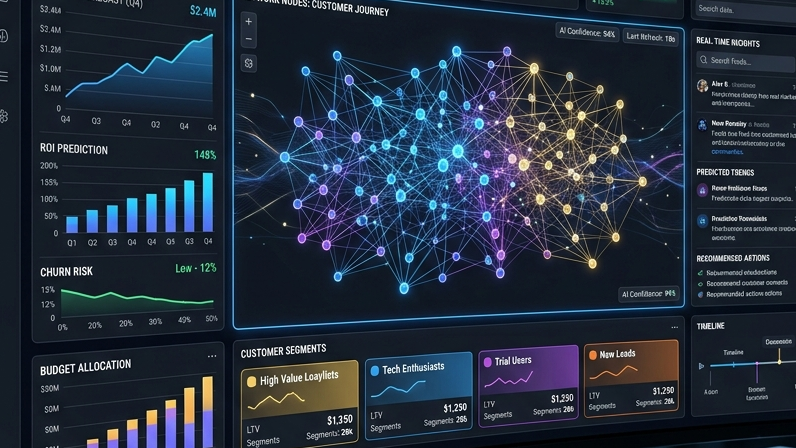
A CDP unifies data. The AI layer activates it. Once you have a clean, unified customer record, you can move from rule-based segmentation ("send this offer to customers who purchased in the last 30 days") to predictive modeling ("identify customers who are likely to churn in the next 14 days and trigger a retention intervention before they do").
This distinction matters enormously for marketing ROI. Rule-based segmentation is backward-looking: it groups customers by what they have already done. Predictive modeling is forward-looking: it groups customers by what they are likely to do. The difference in the precision of the interventions - and therefore in the conversion rates and retention impact - is substantial.
The ML models that power this layer typically include churn propensity scoring, lifetime value prediction, next best offer recommendation, and send-time optimization. Each model requires a different training dataset, a different feature engineering approach, and a different integration with the activation layer. Building these models correctly, keeping them updated as customer behavior evolves, and monitoring them for drift and bias is ongoing data science work.
Generative AI is adding a new dimension here as well. Beyond predictive models, generative models can produce personalized message copy at scale - tailoring the tone, the specific product references, and the call to action to an individual customer's profile. A customer with a history of responding to urgency cues gets a different email than one who responds to social proof. The template is the same; the content is generated individually. Early adopters of this approach are reporting meaningful open-rate improvements compared to traditional segmentation-based campaigns.
First-Party Data Strategy in a Post-Cookie World
The deprecation of third-party cookies - already underway across major browsers, with Safari and Firefox leading and Chrome following - has made first-party data strategy a board-level concern, not just a marketing operations question.
Third-party cookies enabled advertisers to track users across websites without an explicit relationship. They were the backbone of behavioral retargeting, cross-site frequency capping, and the attribution models that underpinned most digital advertising measurement. Their removal forces a fundamental rethink of how organizations identify, reach, and measure the impact of marketing on their customers.
The answer is not simply "collect more first-party data." The answer is collecting first-party data within a framework that users actually consent to, that complies with GDPR, CCPA, and equivalent regulations in relevant jurisdictions, and that is robust enough to serve as the foundation for attribution and activation as third-party signals disappear. This requires a CDP that is architected for consent management from the start, not as an add-on. Consent data needs to flow through the same pipelines as behavioral data, ensuring that every activation decision - every triggered email, every retargeting pixel - is checked against the customer's current consent state before it fires.
Organizations that have invested in this architecture are discovering that compliant first-party data is more valuable than the third-party data it replaces - because it is accurate, consented, and usable without the legal and reputational risk that third-party data now carries.

The GTEMAS Implementation Methodology
Marketing data infrastructure fails for predictable reasons: the integration layer is underestimated, the identity resolution logic is oversimplified, the governance for consent and data quality is not built into the pipeline from the start, and the marketing and engineering teams operate on different timelines with different definitions of success.
GTEMAS takes on marketing-data infrastructure as a Project Delivery engagement, run on FastDX, our AI-native delivery pipeline - engineers from the Talent Ecosystem who understand both the technical architecture and the marketing use cases, owning delivery end-to-end rather than staffing a headcount gap. Our methodology starts with a data audit: what does the organization have, where does it live, what is its quality, and what are the gaps between current state and the unified customer record the marketing team needs?
From there, we design and build the integration architecture - selecting and configuring the CDP, building the event-tracking instrumentation across web and mobile surfaces, connecting CRM and transactional data sources, and implementing the identity resolution logic appropriate to the organization's data environment. We build the AI and ML activation layer in parallel, prioritizing the use cases with the clearest ROI signal: typically churn prevention and next best offer, because these produce measurable outcomes quickly enough to validate the investment before the next budget cycle.
If your organization is operating with a fragmented marketing data environment and you want to understand what a unified architecture would require - technically, organizationally, and financially - the GTEMAS team is glad to start that conversation.