

The Four Eras of Human Capital Management
It helps to understand where we are by understanding where we have been. HRM 1.0 was administrative: paper-based records, manual payroll calculation, and HR departments that existed primarily to manage compliance. HRM 2.0 introduced software: relational databases replaced filing cabinets, and systems like PeopleSoft automated payroll and basic benefits administration. HRM 3.0 moved to the cloud, delivering these capabilities as SaaS platforms (Workday, SAP SuccessFactors, Oracle HCM) with mobile access and integration capabilities that the client-server generation lacked.
HRM 4.0 is a qualitative shift, not just a technology upgrade. The previous three eras automated administrative processes - the mechanics of employing people. HRM 4.0 applies AI and data science to the strategic layer: finding the right people, developing them effectively, deploying them where they create the most value, and identifying retention risks before they become departures. The HR system stops being a system of record and becomes a system of intelligence.
The organizations deploying this capability well are not just buying a new HR platform. They are rethinking how talent decisions get made, who has access to talent data, and what "good" looks like at each stage of the employee lifecycle. The technology is the enabler, but the strategic intent and organizational change are what determine whether it creates value.
AI in Recruitment: Skills-Based Matching at Scale
The traditional recruitment funnel is built around job descriptions and resumes: a recruiter writes a description of the role, candidates write descriptions of their history, and a matching process (human or keyword-based) tries to connect the two. This approach has well-understood failure modes. Job descriptions often reflect what the last person in the role did rather than what the new hire needs to do. Resumes are optimized for keyword matching rather than capability demonstration. And both sides systematically underrepresent potential in favor of credentials.
AI-First recruitment approaches the problem differently. Skills-based matching models represent both roles and candidates as skills graphs - structured representations of capabilities, proficiency levels, and adjacent skills - rather than as text documents. A role might require deep proficiency in financial modeling, working knowledge of SQL, and demonstrated experience managing stakeholder relationships across cultures. A candidate's skills graph is built from multiple sources: structured assessments, work history analysis, project outcomes data where available, and skills self-assessments validated against demonstrated performance.
The practical outcomes of skills-based matching at enterprise scale are meaningful. Multiple industry studies on skills-first hiring report a meaningfully larger qualified candidate pool compared to degree-requirements-based screening, along with shorter time-to-offer for technical roles and better retention for skills-matched hires versus those sourced through keyword screening alone.
This is the same principle behind GTEMAS's own Talent Ecosystem: every engineer carries a verified Skill Profile scored across seven dimensions - Foundational, Technical, Soft Skills, Language & Cultural, Tech Strategy & Consulting, Management & Leadership, and Personal Branding & Social Influence - built from structured assessments rather than resume keywords. When a client staffs a Direct Hire or Staff Augmentation role from that pool, the matching is against demonstrated skills data, not a job-title search.
The important caveat: AI recruitment tools are not bias-neutral by default. Models trained on historical hiring data inherit historical biases. Responsible deployment requires explicit bias testing, diverse training data, and human oversight of AI recommendations - particularly for senior roles and underrepresented candidate pools.
Onboarding as a Data Problem
Employee onboarding is one of the most consequential and least systematically analyzed phases of the talent lifecycle. Multiple studies link structured onboarding to meaningfully better long-term retention compared to an unstructured, checklist-driven first 90 days. Yet most enterprise onboarding programs are designed as compliance checklists rather than capability development experiences.
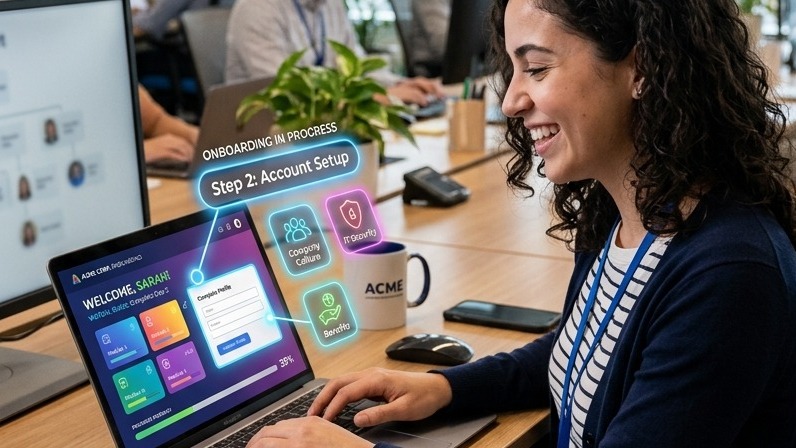
HRM 4.0 approaches onboarding as a personalization problem. Rather than a standard 90-day program that every new hire completes in the same order, AI-First onboarding adapts based on the incoming employee's skills profile, role requirements, and team context. An experienced engineer joining a new product team needs different onboarding than a recent graduate in the same role. A regional manager joining from a competitor needs different preparation than one promoted internally.
The technical implementation typically involves integration between the HRM platform and the organization's learning management system (LMS), with an adaptive learning engine that sequences content based on skills gap analysis and progress signals. More sophisticated implementations include social graph analysis: identifying which existing team members the new hire should connect with early, based on collaboration patterns and role complementarity, to accelerate relationship-building and knowledge transfer.
Attrition Prediction: Acting Before the Resignation Letter
Employee attrition is expensive. Replacing a mid-level professional typically costs 50-150% of annual salary when you account for recruitment costs, productivity loss during vacancy, onboarding time for the replacement, and lost institutional knowledge. Replacing a senior specialist or technical lead can cost significantly more. For organizations with high headcount in competitive talent markets, voluntary attrition is a direct threat to business continuity.
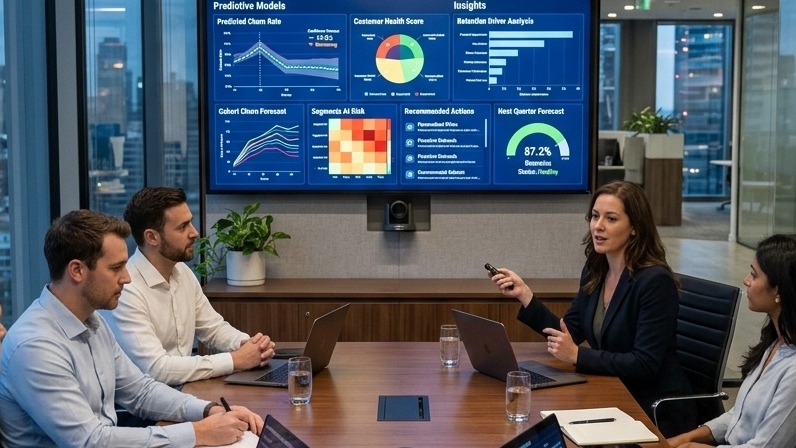
Predictive attrition models analyze behavioral signals that correlate with departure risk, typically weeks to a few months before a resignation occurs. These signals include:
- Decline in engagement metrics (meeting participation, collaboration tool activity, response time patterns)
- Absence of recent internal mobility signals (project applications, internal job views, skills development activity)
- Compensation positioning relative to current market benchmarks for the employee's skills and experience level
- Manager relationship indicators derived from survey data and interaction patterns
- Tenure-based risk patterns: specific tenure milestones correlate with elevated attrition risk in most organizations
When the model flags elevated risk, it enables proactive intervention: a manager conversation about career trajectory, a compensation review against market data, an internal mobility discussion, or a role enrichment conversation. These interventions are significantly more effective when initiated before the employee has decided to leave than after they have started an external search.
One practical consideration: attrition prediction models create significant employee privacy considerations that organizations must address explicitly. Employees whose data is used to generate risk scores should understand that this analysis occurs, what data is used, and what actions it may trigger. Organizations that implement attrition prediction without transparency frameworks expose themselves to trust erosion that can itself become an attrition driver.

Personalized Learning and Development Paths
Corporate learning is historically one of the lowest-ROI investments in the HR portfolio, not because development does not matter, but because most L&D programs are poorly matched to individual need and organizational skill gaps. A mandatory leadership training module delivered to 2,000 managers regardless of their current leadership maturity is expensive to produce and mostly wasted.
AI-First L&D personalization addresses this by combining skills gap analysis at the individual level with learning effectiveness data at the organizational level. The system knows which skills each employee has (from assessments, performance data, and work history), which skills their current and likely future roles require, and which learning experiences have historically been effective at building specific capabilities - not just completion rates, but downstream skills improvement and performance outcomes.
From this foundation, it generates individualized development paths: specific courses, project experiences, mentoring relationships, and stretch assignments sequenced to close the most important skill gaps for each person's career trajectory. These paths are dynamic - they update as the employee's skills evolve, as role requirements change, and as new learning resources become available.
The organizational benefit extends beyond individual development. When every employee's skills profile is current and accurate, workforce planning becomes substantially more data-driven. HR leaders can answer questions like "if we acquire this company, do we have the integration management skills to handle it internally?" or "if we expand into this market, which team members are closest to ready for regional leadership roles?" with data rather than intuition.
The Employee Experience Platform Layer
The intelligence capabilities described above sit on top of an employee experience platform - the interface layer through which employees and managers interact with HR capabilities. In HRM 4.0, this experience layer is unified, mobile-first, and conversational. Rather than navigating to a benefits portal for one task, a learning management system for another, and a performance management application for a third, employees interact through a single interface that integrates these capabilities and surfaces relevant information contextually.
AI assistants embedded in the experience layer handle routine HR queries - leave balance inquiries, benefits questions, policy lookups - that previously consumed HR service center capacity. More sophisticated applications include performance coaching support: AI tools that help managers structure meaningful performance conversations, identify growth opportunities for team members, and recognize contribution patterns that formal review cycles often miss.
GTEMAS Approach to HRM 4.0 Implementation
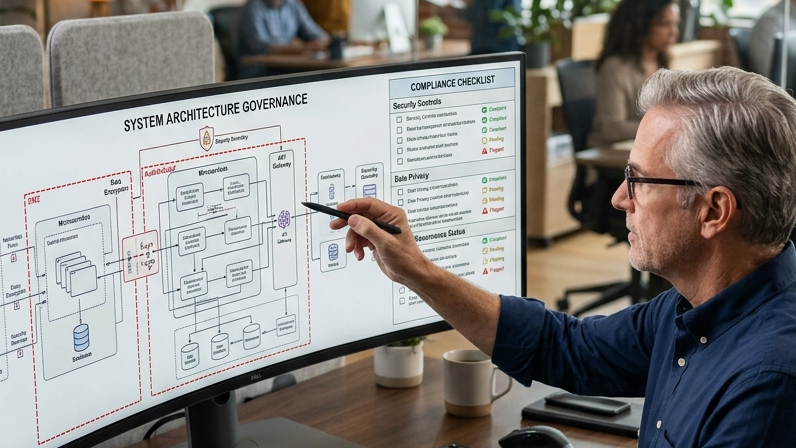
GTEMAS works with HR technology leaders on two levels: the technical implementation (platform selection, integration architecture, data pipeline design) and the organizational design (governance frameworks, privacy policies, change management for managers and employees). The latter is often underfunded and is consistently the determining factor in whether HRM 4.0 investments achieve their intended outcomes.
We evaluate clients' existing HRM platforms against their talent strategy and identify which AI capabilities are additive on top of the current stack versus which require platform migration. Many organizations can realize significant value from skills-based matching and attrition prediction as add-on capabilities to their existing Workday or SAP SuccessFactors deployment before committing to a full platform replacement.
We also bring a working example, not just a framework: GTEMAS's own Talent Ecosystem runs the skills-graph model described above in production today, matching engineers to Direct Hire, Staff Augmentation, and Dedicated Team roles based on a verified Skill Profile rather than a resume. Clients building their own HRM 4.0 capability are welcome to see how that assessment and matching pipeline works before designing their own.

The organizations that treat their workforce as their primary competitive asset cannot afford to make talent decisions on intuition when data-driven alternatives exist. If your organization is evaluating how AI-First capabilities might transform your talent lifecycle, we would welcome a conversation about where the highest-value opportunities are for your specific context.