

The Limits of Static CRM
Most organizations use their CRM as a structured archive. It records what happened: a contact was created, a deal was closed, a support ticket was resolved. The data is accurate, the fields are populated, the reports run on schedule. And it produces almost no competitive advantage, because every competitor's CRM looks identical.
The problem is not the CRM itself. Salesforce, HubSpot, and Microsoft Dynamics are capable platforms. The problem is the layer that should sit above them - the intelligence layer that transforms historical records into forward-looking predictions - and for most organizations, that layer does not exist. The CRM is a rear-view mirror. What modern customer relationships require is something closer to a navigation system: real-time awareness of where the customer is, where they are likely to go, and what intervention will produce the best outcome at the next decision point.
Building that navigation system is an engineering problem as much as it is a data science problem. And it is one that most CRM implementations get wrong not because the technology is unavailable, but because the architecture was not designed for it from the start.

The Architecture of Hyper-Personalization
Moving from a static CRM to a dynamic intelligence system requires rethinking the architecture at three distinct layers. Each layer has its own technical requirements, its own failure modes, and its own organizational implications.
- The data layer (CDP): A Customer Data Platform aggregates behavioral and transactional data from every touchpoint - web visits, mobile app sessions, email interactions, support tickets, in-store purchases, and third-party data enrichment feeds. The CDP resolves identity across these sources (connecting the anonymous website session to the known CRM contact), maintains a unified customer profile in real time, and makes that profile available to every downstream system via a consistent API. Without this layer, the intelligence layer is working with incomplete and stale data. The quality of the unified profile sets a ceiling on the quality of everything built on top of it.
- The intelligence layer (AI/ML): Machine learning models trained on the unified customer profile produce actionable predictions: churn propensity, upsell readiness, next best product recommendation, preferred communication channel, and optimal send time. These models require continuous retraining as customer behavior evolves, monitoring for drift and bias, and clear feedback loops between predicted outcomes and actual outcomes so performance can be measured and improved. This is not a one-time configuration. It is an ongoing data science operation.
- The activation layer: Intelligence is only valuable when it reaches the people and systems that can act on it. In practice, this means surfacing predictions in the CRM interface for sales and service representatives, triggering automated sequences in the marketing automation platform, updating the website's personalization rules in real time, and feeding recommendation engines in e-commerce surfaces. The activation layer needs to work with sub-second latency for real-time use cases (a customer service agent needs to see the churn risk score when the call connects, not 20 seconds later) and with reliable batch delivery for scheduled use cases (campaign audience updates, weekly account health reports).
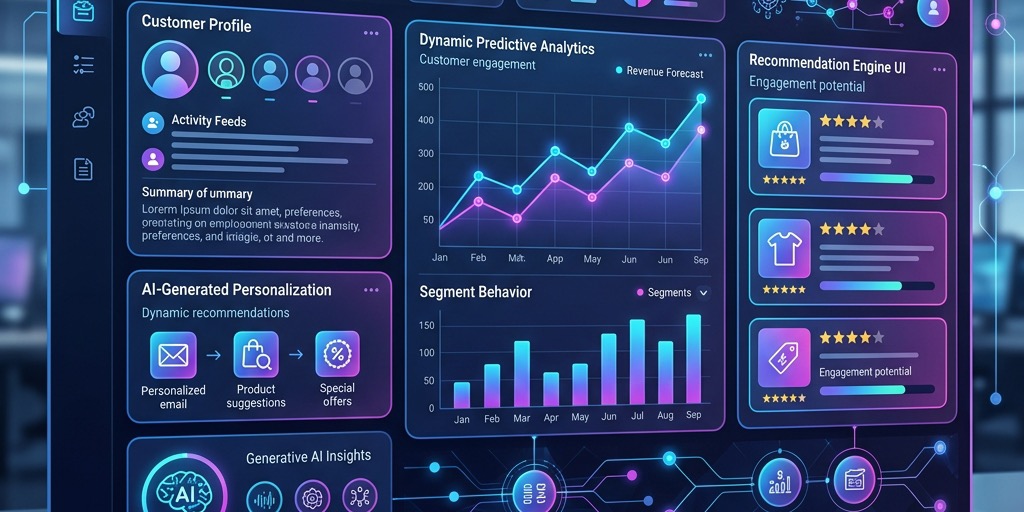
The architecture diagram for this system looks more complex than a traditional CRM implementation, because it is. But the complexity is largely in the data infrastructure layer, not in the CRM itself. The CRM becomes the presentation layer for intelligence that is generated elsewhere.
Generative AI in CRM: Two Practical Applications
Beyond predictive models, generative AI is producing measurable value in two specific CRM use cases that have moved from experimental to operational in the past 18 months.
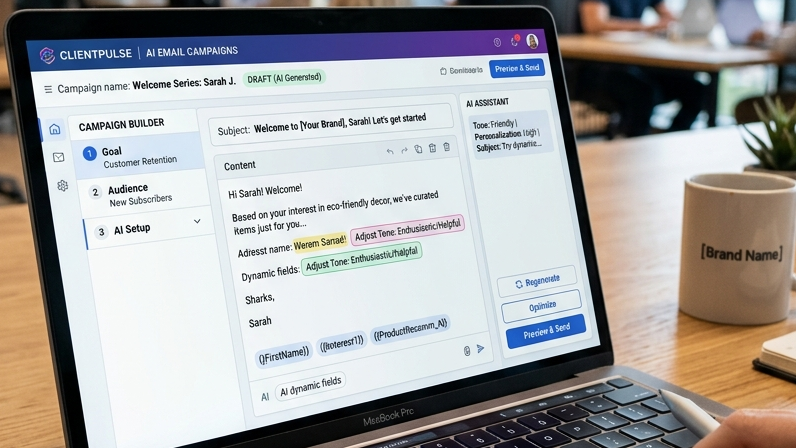
Personalized communication generation: Rather than selecting a template and populating merge fields, AI agents generate email and message content from scratch based on the customer's profile, their recent interactions, and the specific outcome the communication is designed to drive. A retention email for a high-value customer at churn risk is different from a retention email for a recently acquired customer with low engagement - not just in the offer, but in the tone, the framing, the length, and the specific product references. At scale, this requires generative AI. Human copywriters cannot produce individualized content for 100,000 contacts per campaign cycle. Organizations implementing this approach are reporting meaningful lifts in open rates and conversion rates compared to template-based approaches.
"Chat with your data" for sales teams: Natural language query interfaces allow sales representatives to ask questions of their CRM data without writing SQL or navigating complex filter interfaces. "Which accounts in my territory haven't had an activity in 45 days and have an open renewal in the next 90?" becomes an instant answer rather than a 20-minute reporting exercise. More sophisticated implementations allow reps to ask predictive questions: "Which of my open opportunities is most likely to close this quarter?" The system returns not just the answer but the evidence: the activity signals, the engagement patterns, and the historical comparisons that support the prediction.

The Build vs. Buy Decision Framework
When an organization decides to invest in AI-powered CRM capabilities, the first question is typically: should we buy a vendor solution (Salesforce Einstein, HubSpot AI, Microsoft Copilot for Sales) or build a custom intelligence layer?
The honest answer is: it depends on what you are trying to differentiate on.
Vendor AI solutions are appropriate for capabilities that are generic across your industry: basic churn scoring, standard recommendation algorithms, out-of-the-box sentiment analysis for support tickets. These are solved problems. Paying a vendor to solve them is usually cheaper and faster than building from scratch, and the maintenance burden stays with the vendor.
Custom-built intelligence layers are appropriate when the logic of how you define a customer segment, score an account, or generate a recommendation reflects proprietary knowledge about your market and your customers that a generic model cannot replicate. A financial services firm that has developed proprietary risk signals from 15 years of client behavior data is not going to get equivalent predictive accuracy from an out-of-the-box vendor model. A B2B company with a highly specific sales cycle and a narrow universe of potential accounts will see better pipeline prediction from a model trained on its own historical data than from a generic model trained across all Salesforce customers.
The practical approach is a layered one: use vendor solutions for commodity functions, and build custom models for the capabilities that are genuinely differentiated. GTEMAS specializes in designing and building these custom intelligence layers on top of existing CRM platforms - the architecture that connects CDP, ML models, and activation systems without requiring organizations to replace the CRM they have already spent years configuring.
Measuring the ROI
Hyper-personalization investments are often justified with vague claims about customer experience. CFOs want numbers. Here are the metrics that actually move when the architecture is working:
- Churn rate reduction: Organizations that implement predictive churn scoring and automated early intervention workflows typically see 10-20% reductions in voluntary churn within the first year. For a B2B SaaS company with $50M ARR and a 15% annual churn rate, a 15% reduction in churn represents $1.1M in preserved revenue - annually, recurring.
- Upsell and cross-sell revenue: Next best offer models, when properly trained and activated, produce measurable lifts in expansion revenue per account. The mechanism is straightforward: surface the right offer to the right account at the moment when they are most likely to be receptive, rather than running quarterly campaigns to the entire customer base regardless of readiness.
- Sales cycle compression: AI-prioritized pipeline management reduces the time sales reps spend on low-probability opportunities. When a rep starts their week with a ranked list of accounts based on actual behavioral signals rather than gut feel, their close rate on worked opportunities improves.
- Support deflection and resolution cost: AI-assisted triage that routes tickets based on predicted resolution path and surfaces relevant knowledge base articles before human escalation reduces average handle time and deflection rate simultaneously.

The GTEMAS Custom Intelligence Layer
GTEMAS builds the infrastructure that sits between your existing CRM and the AI capabilities your customer-facing teams need. This is not CRM replacement. It is CRM augmentation - adding the data pipeline, the ML models, and the activation integrations that transform your existing system of record into a system of intelligence.
Our engagements typically begin with a data audit and architecture design: mapping the existing data sources, evaluating data quality, and designing the unified profile structure that will power the intelligence layer. From there, we build the integration infrastructure, train initial models on historical data, and deploy activation workflows in the systems your teams already use. The first models are in production within 60-90 days, generating predictions on real data rather than demo scenarios.

If you want to understand what a custom intelligence layer would look like on top of your current CRM - what it would cost to build, what it would produce in measurable business outcomes, and what your organization would need to do to maintain it - the GTEMAS team is ready to have that conversation.